Analysis
Snapdragon X2 Linux Has Booted. Now the Driver Work Starts.
Qualcomm’s September 23 preview describes Linux booting on Snapdragon X2 hardware, with GPU and NPU enablement still progressing. Kernel and distribution developers now have enough to begin serious work. Everyone else should wait before buying an arbitrary X2 laptop and expecting Debian to behave like it does on an ordinary x86 machine.
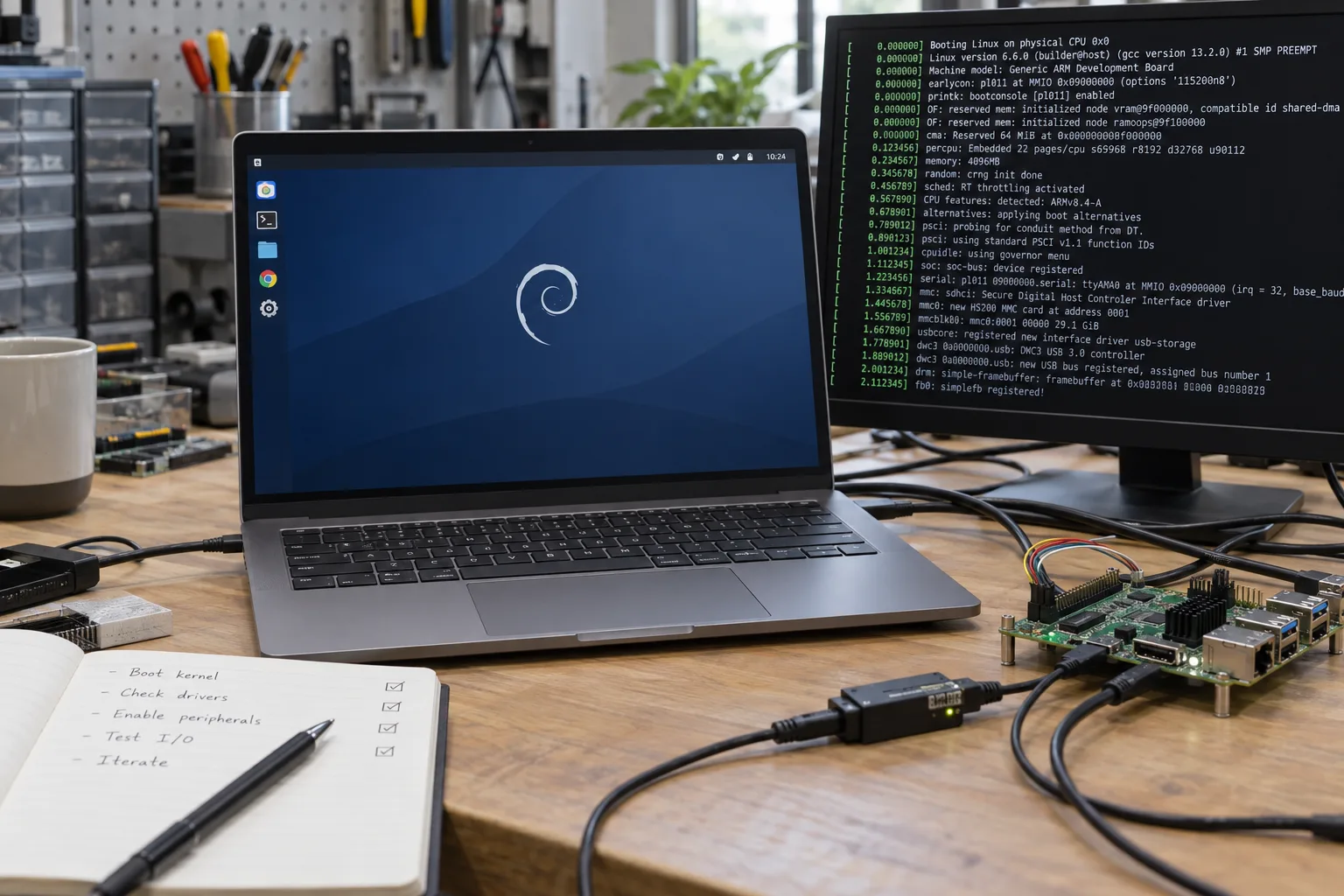
The distinction is easy to lose in the launch language. Qualcomm calls this an Early Developer Preview. The reference environment uses Debian 13 with a custom kernel, hardware support varies by laptop and processor variant, and the September roadmap targets production readiness by the end of November 2026. Ubuntu certification is targeted for the first half of 2027. These are announced targets, not completed certification or availability guarantees.
I find this much more interesting than a polished Linux demo. Qualcomm is discussing boot firmware, device trees, kernel patches, Mesa drivers, NPU access, power management, and upstream review. Those are the unglamorous pieces that decide whether a machine remains useful after the launch team moves on.
In this article
Booting Linux is the beginning of hardware support
A Linux desktop can appear while important hardware remains fragile or unavailable. The display may work through a narrow path while external monitors do not. Wi-Fi can associate while suspend drains the battery. A GPU can draw a desktop without providing stable video acceleration or compute. Audio, webcams, fingerprint readers, sleep states, and firmware updates often fail in combinations specific to one laptop.
Qualcomm’s preview starts below that desktop layer. It describes UEFI boot through systemd-boot, USB and PCIe, the company’s Universal Peripheral engine for UART, I2C, and SPI, Adreno graphics through Freedreno, Turnip, and Rusticl, and Hexagon NPU access through FastRPC. Power, thermal behavior, and system stability remain active work.
That list is encouraging because it names subsystems instead of declaring “Linux support” as one binary feature. It also shows how much work remains between a development board that reaches a shell and a laptop I would trust for a full workday.
Upstream drivers change the maintenance equation
Vendor kernels can make a new machine look finished. They carry a private patch set, boot the launch image, and satisfy a demonstration. Problems arrive later when a distribution updates its kernel, the vendor branch stops moving, or a security fix has to be reconciled with code that never reached mainline.
Qualcomm says it is upstreaming core X2 support, including Adreno GPU and Hexagon NPU work. Its preview describes a mixture of work being reviewed, merged, and still developed. Naming a subsystem in that roadmap does not establish that support for the exact laptop is in a released kernel or Mesa package.
Mainline acceptance does not make every laptop work automatically. OEMs still choose panels, cameras, audio codecs, touchpads, radios, and firmware. Device trees and ACPI descriptions still need to match real machines. Distribution maintainers need to package the user-space pieces, installers must understand the platform, and firmware has to expose the interfaces the drivers expect.
It does move the maintenance work into the places where the Linux ecosystem can review and carry it. A driver in the kernel and Mesa has a chance to follow API changes, receive fixes, and reach several distributions. An opaque image on a vendor download page remains tied to that image.
Debian 13 is a reference environment, not a compatibility promise
Qualcomm’s September preview was validated with a Debian 13 user space and a custom kernel. That phrasing matters. Debian is supplying the userland around a platform kernel that is still being assembled; this is not a statement that the normal Debian installer fully supports every Snapdragon X2 laptop.
The initial audience is distribution maintainers, driver developers, toolchain developers, and hardware-enablement teams. Qualcomm explicitly says a turnkey install-and-go experience comes later as distributions adopt the upstream work.
Canonical is targeting certified Ubuntu support in the first half of 2027, and Qualcomm names HP, ASUS, and HUMAIN as partners planning Linux systems. Certification should narrow the matrix to specific hardware that an OEM and distribution have agreed to test. It will not make every Windows model with the same processor equivalent.
If I were buying one for Linux, I would select the exact certified laptop, not the processor family. The logo on the CPU tells me which code may exist. The laptop model tells me which collection of peripherals and firmware I must live with.
The NPU is useful only when the software path survives
Qualcomm understandably puts the Hexagon NPU near the center of its announcement. Local inference is part of the reason ARM laptops are receiving so much attention, and FastRPC is the route that lets Linux applications reach the accelerator.
The durable question is whether common runtimes can use it without being welded to one demonstration stack. Developers need maintained drivers, documented interfaces, model conversion that does not destroy accuracy, profiling tools, predictable memory behavior, and a fallback path when an operation is unsupported. Container support and repeatable deployment matter more to me than a single model reaching a headline number.
GPU compute has the same requirement. Freedreno, Turnip, and Rusticl put the work in open Mesa drivers, which is a better starting point than a permanently vendor-pinned graphics package. Performance and completeness will still need testing on shipping hardware.
ARM laptop compatibility remains a complete-system problem
The processor is only one compatibility layer. Linux software repositories need ARM64 packages. Proprietary native applications may remain x86-only. A JavaScript browser extension is not inherently tied to x86, but an extension that communicates with a native helper also needs that helper to work on ARM64 Linux. Browser API support and native binary availability are separate checks. Development containers may reference images that were never published for ARM. Teams that depend on nested virtualization, unusual USB devices, VPN clients, endpoint agents, or vendor-specific flashing tools need to test those pieces individually.
I have used Debian on servers for roughly 25 years and Arch on workstations for more than a decade. The distribution rarely worries me as much as the hardware support underneath it. A package problem can often be rebuilt or replaced. An undocumented suspend bug or unsupported camera interface follows the machine everywhere.
This is also why I would not grade Snapdragon X2 Linux from a launch-day desktop screenshot. I would want suspend and resume loops, external-display testing, webcam and microphone use, accelerated browsers, storage and network load, thermal throttling, battery measurements, kernel upgrades, and recovery from a failed update. Those tests reveal whether the platform behaves like a computer rather than a development kit.
What I would wait for before buying
The preview is good news for Linux, especially because Qualcomm is publishing a roadmap and working upstream. It also makes waiting easy.
I would look for mainline kernel support covering the exact X2 variant, Mesa releases containing the relevant graphics work, a distribution installer that recognizes the laptop, OEM-published firmware updates, working suspend and external displays, and an explicit list of unsupported devices. For local AI work, I would add one end-to-end runtime that can be installed from documented packages and reproduced outside Qualcomm’s demo environment.
People doing kernel, Mesa, or distribution enablement now have a platform worth testing. Most workstation buyers should let them find the sharp edges first.
Before committing to a machine, record the exact model and firmware, the kernel and Mesa versions used in a successful test, and any required out-of-tree patches. Then check whether the distribution’s next supported update preserves those components. A demo image that works once is not yet a maintenance plan.
Sources
- Qualcomm Developer Blog, Linux on Snapdragon X2 Series Early Developer Preview.
- Qualcomm OnQ, Snapdragon Summit 2026 platform and partner announcement.
- Linux kernel documentation, submitting and reviewing patches for the upstream kernel.
- Mesa 3D, Freedreno driver documentation.
Updated October 10, 2026: Clarified the September roadmap’s planned status and the distinction between browser extensions and native helpers. This remains an analysis of the published preview, not a hands-on laptop test.