Workbench
Do You Need a Lutron Caséta Hub for Home Assistant?
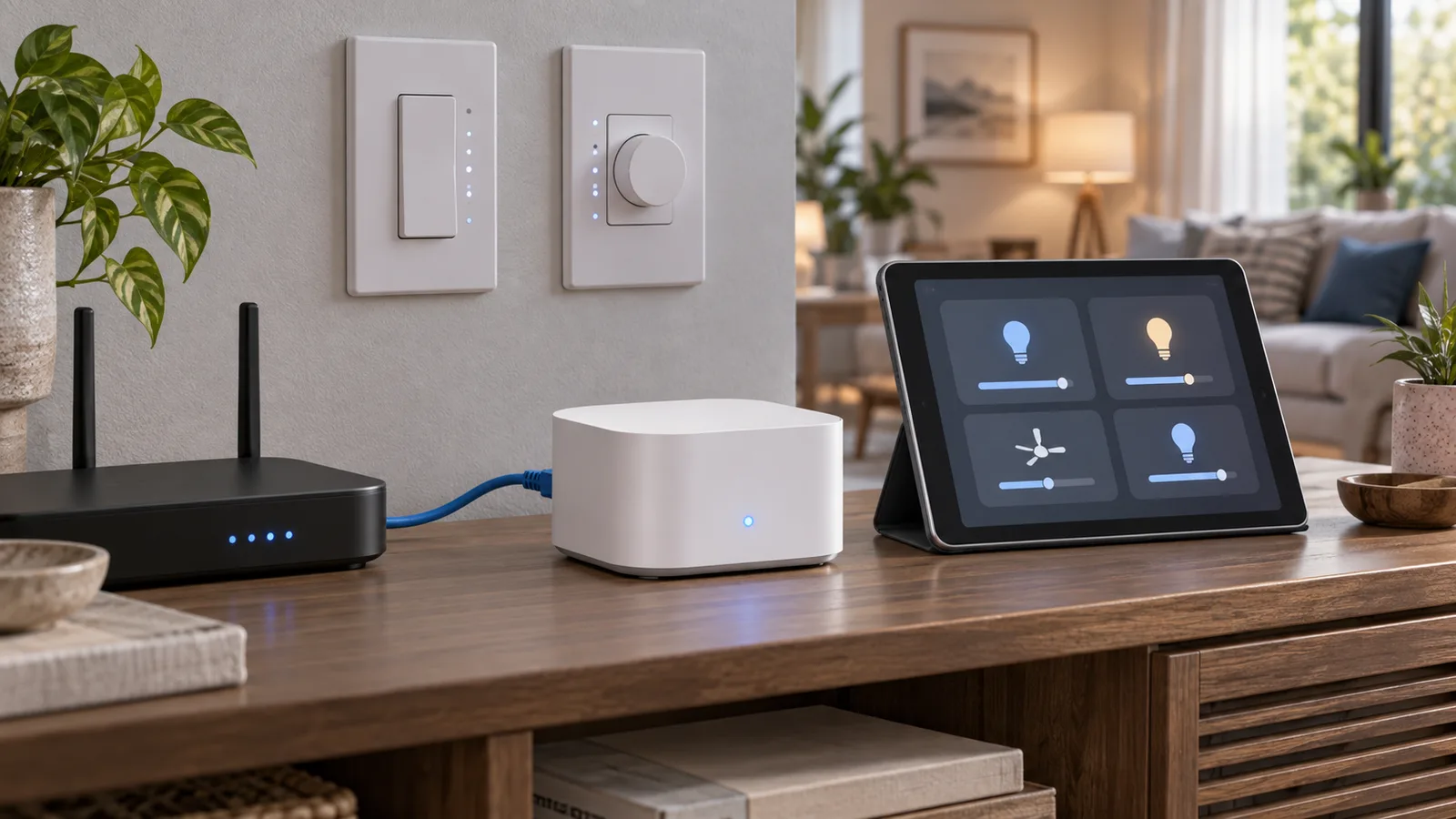
Yes: for Lutron Caséta controls in Home Assistant, I use a Caséta Smart Hub. The standard L-BDG2 is enough for my setup. I do not have a Pro hub, and I do not need one merely because I use Home Assistant.
What one hub handles here
The live device registry shows one L-BDG2 Smart Hub, nine PD-6WCL dimmers, eleven PD-8ANS switches, three PD-FSQN fan controls, two PJ2-3BRL Pico remotes, and one PJ2-2B Pico remote. That is 26 physical controls plus the hub.
The count matters because it turns “you need a bridge” into a less annoying purchase. The hub is not an adapter I bought for one switch. It is the common path for the Caséta controls across the house. Lutron’s current guidance allows up to 75 Caséta devices per hub, including the hub itself, so this installation is not close to that published limit.
I would still count before buying into a large system. Picos and other controls consume device slots, and “75 devices” is not the same as 75 rooms. My inventory is evidence for what runs here, not a promise about range or capacity in another house.
Why the standard L-BDG2 is enough
| Question | My answer |
|---|---|
| Does Home Assistant support the standard hub? | Yes. L-BDG2-WH is explicitly listed. |
| Do I need the Pro hub for ordinary Caséta entities? | No. My standard hub exposes the supported dimmers, switches, fan controls, scenes, and Pico events I use. |
| Does the hub connect by Wi-Fi? | No. It connects to the router by Ethernet. |
| Do Caséta controls use household Wi-Fi? | No. They use Lutron Clear Connect to reach the hub. |
| Will the wall controls work if Home Assistant is down? | Yes. The basic physical control path does not depend on Home Assistant. |
| Would I buy a hub by itself? | Only if I already had compatible Caséta controls. For a new system, I would compare a starter kit with the separate parts. |
Home Assistant’s current Caséta integration lists both the standard L-BDG2-WH and the L-BDGPRO2-WH. That is the important distinction. “Pro” is not a prerequisite hidden in the Home Assistant documentation.
The Pro hub exists for additional professional integration cases. If a shade model, A/V system, or security integration specifically names the Pro hub, that requirement should decide the purchase. I would not pay the difference because the word sounds safer or because an old forum post was written against an older integration path.
The hub is the local translator
The controls do not join the Wi-Fi network one by one. They speak Lutron’s Clear Connect radio protocol to the hub. The hub plugs into the network by Ethernet, and Home Assistant talks to that supported bridge.
That separation is one of the reasons I like Caséta for permanent lighting. Adding another wall control does not add another Wi-Fi client, cloud login, or battery-powered mesh router. The wall control still operates its load when Home Assistant is restarting. Home Assistant adds orchestration without becoming the only path to light.
The official integration is classified as Local Push. Supported devices are discovered from the Caséta system and become the appropriate Home Assistant entity types: dimmers as lights, wall switches as switches, fan-speed controls as fans, and Pico buttons as triggers.
Local does not mean configuration-free. I still had to set up the Caséta system, put the hub on Ethernet, and add the integration. Lutron’s app is part of initial Caséta programming, while Home Assistant’s current interface can discover the hub and guide pairing. I would also give the hub a stable address through a DHCP reservation so a network change does not turn into a mystery later.
What happens when something is offline
If Home Assistant is down, the physical Caséta controls still operate their assigned loads. That is the failure boundary I care about most. A visitor does not need the dashboard to turn on a ceiling light.
If the hub is unavailable, Home Assistant loses its path to the Caséta system. The individual wall dimmers and switches do not suddenly become Wi-Fi devices and bypass it. I would check hub power, Ethernet link, address assignment, and the Home Assistant integration before touching every switch in the house.
If the internet is unavailable, Lutron says its controls and hub do not need Wi-Fi or internet to communicate inside the home. Remote app features and outside services are a separate boundary. I do not combine “the light still works locally” with a claim that every cloud feature keeps working.
When I would buy the hub
- I am starting a Caséta system that will connect to Home Assistant. The hub is part of the architecture, not an optional later optimization.
- I already have compatible Caséta controls running without a hub. One hub can make the system available to Home Assistant and the Lutron app.
- I want Pico remotes as automation inputs. Home Assistant can expose supported Pico button events through the integrated Caséta system.
- I want permanent lights to stay conventional at the wall. The hub adds coordination without moving the basic control into a smart bulb.
When I would not buy it
I would not buy an L-BDG2 for a house with no Caséta controls. It is not a generic Matter controller, Zigbee coordinator, Thread border router, or Wi-Fi bridge. It has one clear job.
I also would not buy the Pro model without naming the Pro-only requirement first. Home Assistant support alone is not that requirement. And I would not add a second hub just because one room is far away before checking Lutron’s placement and range guidance; splitting a system creates another inventory and coordination boundary.
Finally, I would not choose the hub before choosing the load control. A dimmable light, non-dimmable light, fan, shade, and loose lamp do not all want the same device. The hub does not make a mismatched dimmer safe or turn an unsupported load into a supported one.
The hub decision
For this house, the standard L-BDG2 is the right hub because it already supports the Home Assistant path I use and has ample documented capacity for the current 26 controls. If I were starting from zero, I would price the required dimmer or switch, Pico, wall hardware, and hub both separately and as a current starter kit. The cheapest box is not automatically the cheapest complete room.
For the controls themselves, read why I keep my original PD-6WCL dimmers but would start a new room with Diva, why I keep my older switches but would check Claro for a new on/off circuit, and which installed Caséta models need a neutral. The broader split between wall controls and lamps is in my Caséta-versus-Matter buying rule.
Where the hub claims come from
The installed model and counts come from my live Home Assistant registry. The supported-hub and entity behavior comes from the Home Assistant Caséta integration documentation. Ethernet, Clear Connect, standard-versus-Pro naming, and local operation come from Lutron’s Smart Hub guide. The 75-device limit comes from Lutron’s current programming guidance.
I have not tested a Pro hub in this house. My conclusion is narrower: the standard L-BDG2 is sufficient for the Caséta devices and Home Assistant behavior described here.
Disclosure: I own and use the L-BDG2 and Caséta controls described here. The hero is a generated editorial illustration, not product photography. The external links currently go to official documentation, not affiliate links. If a product link later pays a commission, I will label that relationship on the page.